Food Provenance as an Illustrated Supply-Chain Map — AI Image Prompt Guide
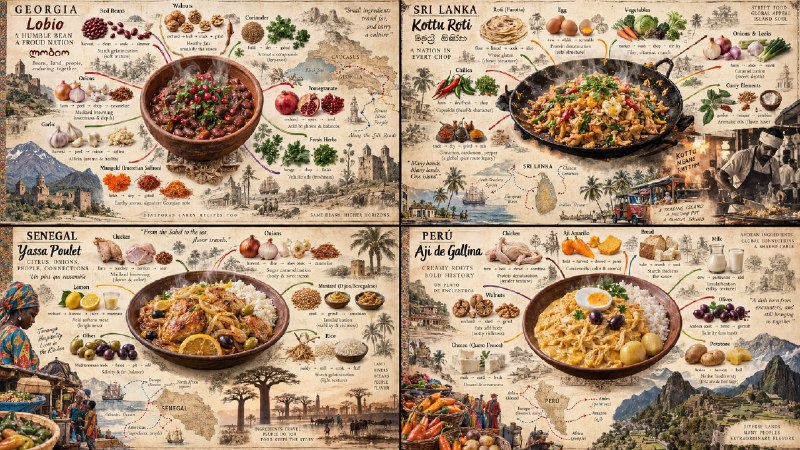
Create a 16:9 food-manuscript-style composition with a realistic finished dish at the centre. Trace ingredient origins through a surrounding supply-chain map.
English translation of the public case notes.
Text-to-image case combining food photography, information design and nautical mapping. Supply one or more less familiar world dishes, ideally with country, main ingredients and serving vessel specified. The 16:9 manuscript-style scene places a realistic finished dish centrally, with ingredient origins radiating around it. Suitable uses include recipe covers, food-culture explainers, supply-chain visuals and regional ingredient stories. Define format, dish variables, viewpoint and medium first, then food texture, then the surrounding routes, colours and line-weight rules. Avoid routes so dense they bury the dish, unreadable origin labels and an unidentifiable mixture of different national dishes. Practical controls: • Order the information as central dish, surrounding origin nodes, then connection rules. • Give line colours ingredient meanings and line thickness an explicit interpretation. • Make nodes concrete: markets, warehouses, farms, genetic origins and sea-trade links, rather than purely decorative marks.
Original case notes (Chinese)
⚖️ 对照测试|把一道菜画成溯源地图 玩法测试:文生图 / 图像编辑。 这次不只看成图,还看:这个案例把美食摄影、信息图和航海地图融合起来,用“中心成品菜+放射状食材来源线”组织复杂画面。适合做菜谱封面、饮食文化科普、供应链可视化和地域食材故事。 测试结论: 类型:文生图 输入:一道或多道较冷门的世界菜名,最好明确国家、主要食材和上桌器皿 目标:生成一张16:9美食手稿式画面,中心是写实成品菜,周围用供应链地图追踪食材来源 关键词:冷门菜肴 / 食材溯源 / 供应链制图 / 美食手稿 / 放射构图 / 写实摆盘 / 航海贸易地图 重点:先定义画幅、菜品变量、视角和媒介,再描述中心菜品的质感,最后规定外圈线路、颜色和粗细逻辑 约束:避免食材线路过密导致主体被淹没;避免来源节点文字不可读;避免把不同国家菜肴混成无明确身份的拼盘 💡 最值得记下的三点 • 用“中心成品菜—外圈来源节点—连接线规则”的顺序控制信息层级 • 为线路指定食材代表色和粗细含义,让图像不只是装饰而有可读逻辑 • 将“市场、仓库、农田、遗传起源、海上贸易”等节点具体化,提升叙事密度 #GPTImage2 #OpenAI #AI绘画 #美食溯源 #手稿地图 #放射构图