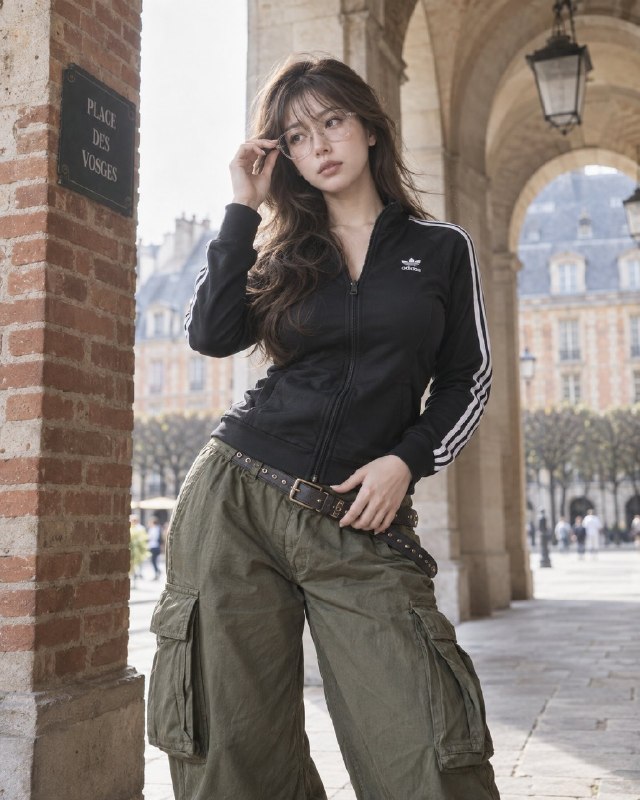
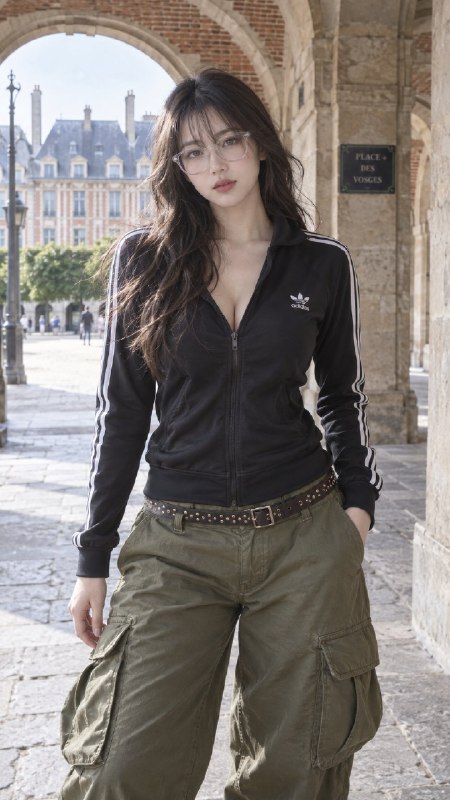
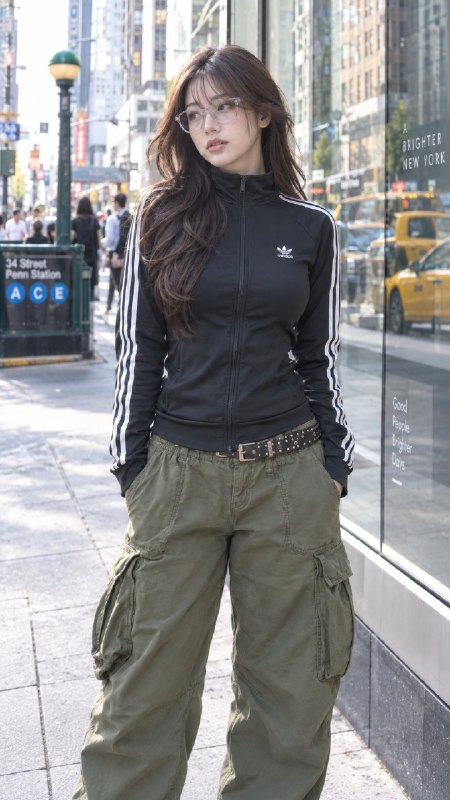
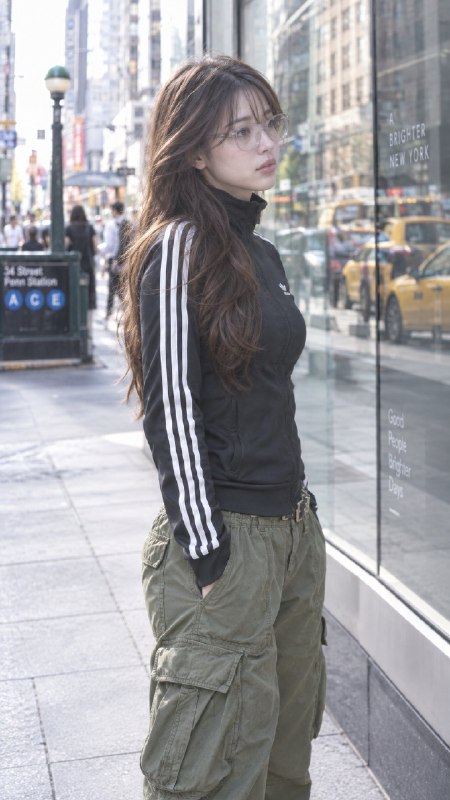
完整提示词
中文提示词
GPT Image 2.5:
写实编辑人像。

场景是曼哈顿街角的玻璃立面、反光的店铺墙面,玻璃中反射出出租车的形状。
她呈站立姿势。
漫射环绕光,主体上有宽广柔和的补光。
膝盖以上的牛仔镜头构图。

一位 20 多岁、妩媚迷人、惊艳的日本或韩国女性,佩戴透明镜框、粗框眼镜,F–G 罩杯胸围,四肢纤细,腰部窄而清晰,臀部圆润,长腿,戏剧性的纤瘦沙漏轮廓;身高 168–173 厘米,胸腰臀 94–58–92 厘米;长而柔软的波浪发,带空气感刘海,浪漫波浪形状明确,脸周发尾干净,带轻微风吹动感,柔和的方向性流动,少量自然散落发丝,整体轮廓受控;柔和的红茶棕色头发,低饱和棕黑色沙龙发色;表情若有所思、带反省感,内侧眉毛略微收紧,眼睑柔和,嘴唇放松,面部有细微紧张感。

她穿着黑色合身 adidas 拉链运动夹克,立领,光滑 tricot 面料,两只袖子从肩部到袖口各有三条平行对比色条纹,前拉链完全拉上,衣摆自然垂落在腰头和下装上部之上,并部分遮住它;橄榄绿色 balloon cargo pants,宽容量桶形裤腿,膝部塑形明显,大号风琴侧袋,收窄裤口;装饰性铆钉皮腰带松松地系在髋部,带金属铆钉和小巧的偏心带扣。

受川内伦子启发的轻盈高调影像语言。

Fujifilm Provia 胶片模拟,干净平衡的色彩,通透肤色,明亮自然的对比度,清晰的日光中性呈现。

请生成同一瞬间的四张独立照片。

第一张照片遵循原始提示词的相机角度和构图。

第 2–4 张照片,请自由选择另外三个明显不同的相机视点。四张照片必须具有不同的观看角度,不能重复或使用几乎相同的视点。仅改变裁切、变焦或画面倾斜不算不同视点。

在四张照片中保持同一人物、服装、配饰、姿势、表情、头部方向、场景、光线和视觉风格一致。保持人物和场景的物理布置不变;只移动相机。人物不得转身或调整姿势去面向每台相机。

第 2–4 张照片只覆盖原始相机视点,并根据需要调整取景。允许透视、可见背景和自然裁切随相机位置改变。
英文提示词
GPT Image 2.5 :
Photorealistic editorial portrait.

The setting is Manhattan corner glass facade, reflective storefront wall, taxi shapes reflected in glass.
She presents a standing pose.
Diffused wraparound light, broad soft fill across the subject.
Knee-up cowboy shot.

A 20s seductive stunning Japanese or Korean woman with clear transparent frame, bold thick-frame glasses, F–G cup bust, lean limbs, narrow defined waist, rounded hips, long legs, dramatic lean hourglass silhouette; height 168–173 cm, bust–waist–hip 94–58–92 cm, long soft waves with see-through bangs, defined romantic wave shape, clean face-framing ends, lightly wind-swept movement, gentle directional flow, a few naturally loose strands, controlled overall silhouette, soft black-tea brown hair, muted brown-black salon tone, thoughtful reflective expression, slightly drawn inner brows, softened eyelids, relaxed lips, subtle facial tension.

She wears black fitted adidas zip-front track jacket, stand-up collar, smooth tricot fabric, three parallel contrast stripes from shoulders to cuffs on both sleeves, front zipper fully zipped closed, its hem draping naturally over the waistband and upper portion of the lower garment, partially concealing it, olive green balloon cargo pants, high-volume barrel legs, deep knee shaping, large bellows side pockets, tapered cuffs, decorative studded leather waist belt worn loosely around hips with metal studs and compact off-center buckle.

Rinko Kawauchi-inspired airy high-key image language.

Fujifilm Provia film simulation, clean balanced color, transparent skin tones, bright natural contrast, crisp daylight-neutral rendering.

Please generate four separate photographs of the same moment.

For the first photograph, follow the original prompt’s camera angle and composition.

For photographs 2–4, freely choose three other clearly different camera viewpoints. All four photographs must have distinct viewing angles, with no repeated or nearly identical viewpoints. Changing only the crop, zoom, or image tilt does not count as a different viewpoint.

Keep the same character, clothing, accessories, pose, expression, head direction, scene, lighting, and visual style across all four photographs. Keep the person and the physical arrangement of the scene unchanged; move only the camera. The person must not turn or adjust their pose to face each camera.

For photographs 2–4, override only the original camera viewpoint and adjust the framing as needed. Allow perspective, visible background, and natural cropping to change with the camera position.